
Ewa Gentry Unclaimed Money
Ewa Gentry residents have two places to search for unclaimed money. The Hawaii state unclaimed property program, managed by the Department of Budget and Finance, holds dormant bank accounts, insurance refunds, uncashed checks, utility deposits, and other assets reported by businesses that lost contact with their owners. The Honolulu city government also keeps a separate list of escheated checks, which are city-issued checks that went uncashed. Both programs are free to search and free to claim from. No cost at any step.
Ewa Gentry Overview
Where to Search Ewa Gentry Unclaimed Money
Ewa Gentry sits on the Ewa Plain in west Oahu, within Honolulu County. Two separate databases apply here, and you need to check both. The state system is at unclaimedproperty.ehawaii.gov. It holds property reported statewide. Enter any name, current or past, and browse the results. The database shows the name of the business that reported the property, the type of property, and the value when that information was provided. Searching is instant and free.
The second database is the Honolulu escheated checks list at honolulu.gov/bfs/escheated-checks/. Honolulu city issues a lot of checks, including vendor payments, tax refunds, permit refunds, and other city payments. When those checks are not cashed, the city eventually escheats them. The database lets you search by payee name, dollar amount, or check number. Records run from 2022 to 2025. If you find a match, the claim form is right on the site. The Treasury Division processes those claims from its office at 530 South King Street in downtown Honolulu.
The screenshot below comes from the escheated checks page that Ewa Gentry residents use to look up city funds.
The Honolulu Bureau of Budget and Fiscal Services escheated checks page is the city database for uncashed Honolulu checks, including those issued to Ewa Gentry payees.
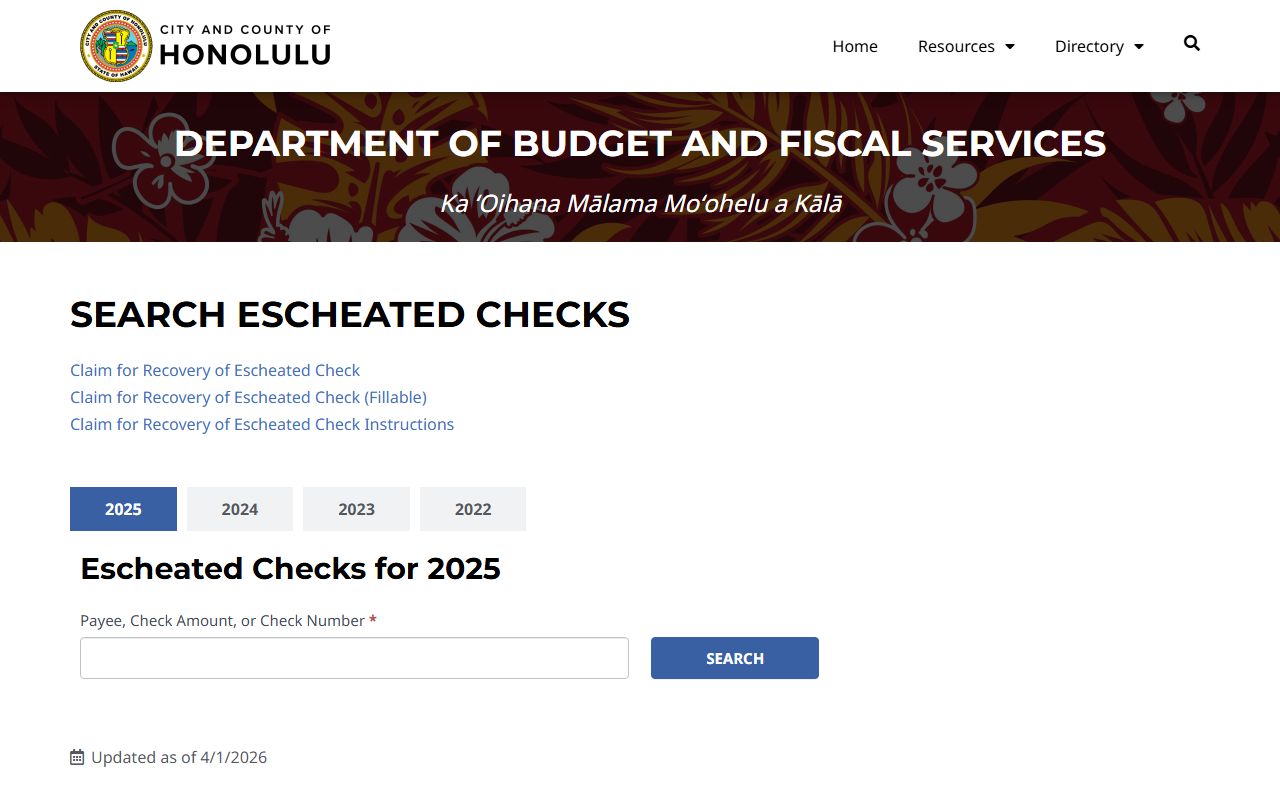
Ewa Gentry residents can search by name, amount, or check number to find city-issued checks that were never cashed.
Types of Unclaimed Money in Ewa Gentry
The state program collects a wide range of assets. Dormant bank accounts are the most frequently reported. Checking and savings accounts go unclaimed after five years of no owner contact. A certificate of deposit sits for seven years before the bank must turn it over. Life insurance money is reported after three years when an insurer cannot locate the named beneficiary. Wages and payroll checks become unclaimed in just one year. If you worked somewhere and never cashed a final paycheck, it may already be in the state system.
Utility deposits come up often for newer communities like Ewa Gentry, where a lot of residents have moved in recent years. When a utility issues a refund and cannot reach the customer, that deposit goes to the state. Stock dividends and shares work similarly. Any brokerage or transfer agent that loses track of a shareholder must report those assets to the state after three years. The state holds the cash value or, in some cases, the actual securities. Other property types include safe deposit box contents, insurance premium refunds, gift card balances from certain issuers, vendor overpayments, and court-ordered refunds.
All holders are required to report and remit under Hawaii Revised Statutes Chapter 523A. This applies to banks, insurers, brokers, utilities, and any other business or organization holding assets belonging to a Hawaii resident they cannot locate.
Note: Traveler's checks have a 15-year dormancy period, the longest of any property type under Hawaii law.
How to Claim Ewa Gentry Unclaimed Money
Start with the state search at unclaimedproperty.ehawaii.gov. Try your full name, any name you have used, and names of family members who lived in Ewa Gentry. When you find a record, the site lets you start the claim online. You fill out the form, attach any required documents, and submit. The full list of documents by claim type is on the owner information page at budget.hawaii.gov.
Claims under $50 often need only basic identity information. Claims over $50 require your signature to be notarized. Take the printed claim form to any bank or notary public in Ewa Gentry or the surrounding area. Sign it in front of the notary, get the stamp, and send or upload the signed form. Most banks provide notary services to their customers at no charge. After you submit, the state typically processes the claim within 90 days. You can check the status by calling (808) 586-1589 or using the contact form at budget.hawaii.gov.
Heirs claiming property for a deceased family member need an Affidavit for Collection of Personal Property of Decedent under Hawaii Revised Statutes Sections 560:3-1201 and 560:3-1202. Attach a death certificate and documents showing your relationship to the deceased. Securities claims also need IRS Form W-9 for tax reporting purposes.
Below is the state owner information page that Ewa Gentry claimants use to find the right documents for their claim type.
The Hawaii state owner information page lists requirements for original owner claims, heir claims, and business entity claims.
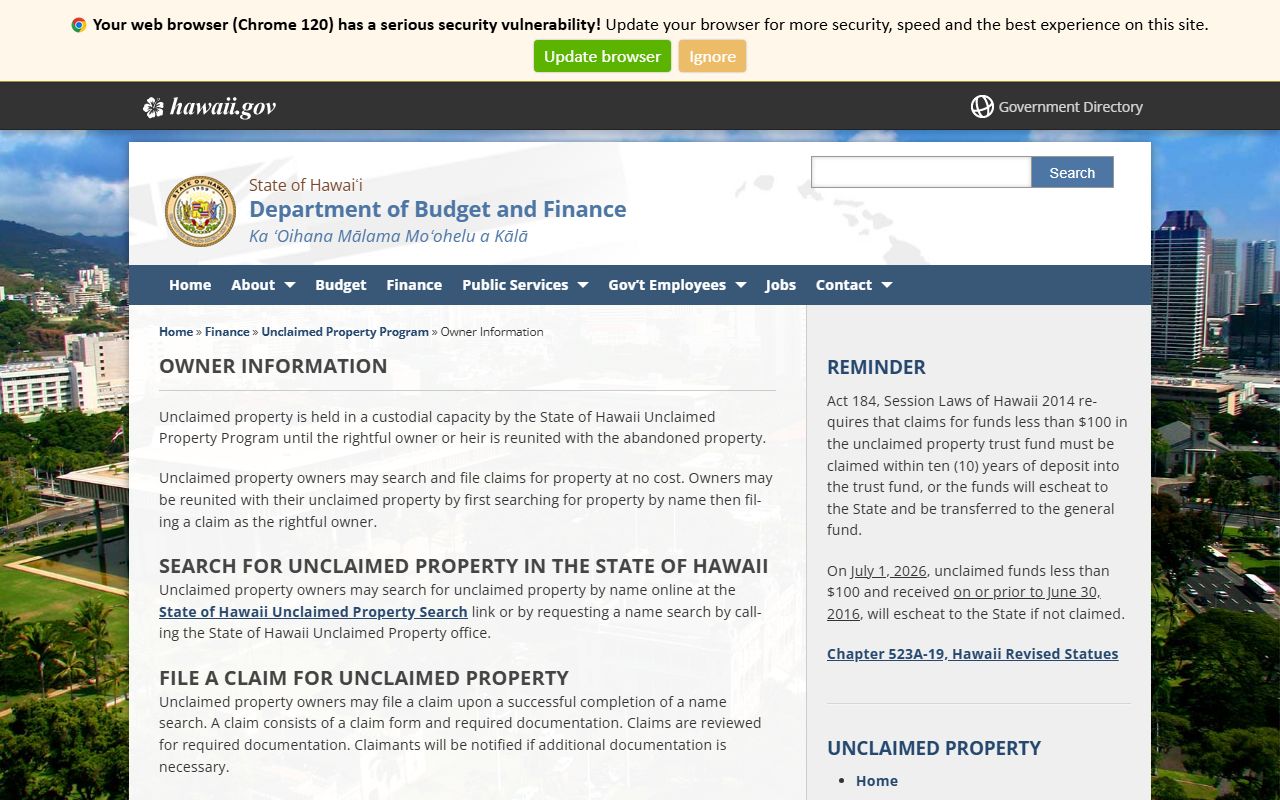
Ewa Gentry residents can use this page to confirm what documents they need before submitting a claim to the state program.
Honolulu County Resources for Ewa Gentry
Ewa Gentry is in Honolulu County. All state unclaimed property claims from this area are managed by the Hawaii Unclaimed Property Program in downtown Honolulu. The physical office is at 250 S. Hotel Street, Room 304, Honolulu, HI 96813. Mailing address is P.O. Box 150, Honolulu, HI 96810. Office hours are Monday through Friday, 7:45 a.m. to 4:30 p.m. HST. Phone is (808) 586-1589. Almost everything can be done by mail or online, so Ewa Gentry residents generally do not need to make the trip to Honolulu.
For the city escheated checks program, the Bureau of Budget and Fiscal Services at honolulu.gov/bfs/ is the right contact. City financial claim forms are at honolulu.gov/bfs/financial-forms/. The Treasury Division is at 530 South King Street, Room 115. If you have questions about whether a specific check is included in the city escheated list, that office can help. Most questions can also be answered through the BFS website without calling.
Ewa Gentry Unclaimed Money Laws
The legal framework for unclaimed property in Hawaii is HRS Chapter 523A. This statute requires any business that holds property belonging to a Hawaii resident, and cannot locate that person, to report it to the state after a set dormancy period. Before reporting, the holder must attempt to reach the owner by mail. After the property transfers to the state, the owner retains the right to claim it with no time limit. Hawaii does not cut off that right for most property types.
Section 523A-25 limits finder fees to 10 percent of the claimed value. A finder is a third-party company that searches the database on your behalf and charges for the service. You are never required to use one. The state database is public and free. You can do the same search yourself and keep 100 percent of what you recover. There is no advantage to paying a finder unless you want to delegate the work.
One deadline exists under Act 184. Unclaimed funds under $100 that were received by the state on or before June 30, 2016, will permanently escheat to Hawaii on July 1, 2026. After that date, those specific small-dollar amounts cannot be claimed. If you have money from before 2016 in the system and it is under $100, check and file now. Property over $100 and property received after June 30, 2016, is not subject to this cutoff. Questions about dormant bank accounts and credit unions can be directed to the Division of Financial Institutions FAQ at cca.hawaii.gov.
Honolulu County Unclaimed Money
Ewa Gentry is within Honolulu County, and the county page has more detail on the state program offices, claim help resources, and how the program works across all of Oahu. Visit the county page for more information.
Nearby Cities
These west Oahu communities near Ewa Gentry use the same state and Honolulu city unclaimed money programs.