
Unclaimed Money in Kalawao County
Kalawao County is the smallest county in Hawaii and one of the most unusual in the United States. Located on the Kalaupapa Peninsula on the north coast of Molokai, it has no elected county government of its own. Residents and former residents who need to search for unclaimed money use the statewide Hawaii Unclaimed Property Program through the Department of Budget and Finance. The search is free, and it covers all property reported under a Kalawao County or Kalaupapa address.
Kalawao County Overview
About Kalawao County and Its Unique Status
Kalawao County is not like any other county in Hawaii or the United States. It sits on the Kalaupapa Peninsula on the north shore of Molokai, cut off from the rest of the island by sea cliffs that rise hundreds of feet. The only land access is via a steep mule trail. There is no elected county government. Kalawao is a judicial district of Maui County, meaning Maui County handles governmental functions for the area.
The peninsula is home to Kalaupapa National Historical Park, which is administered by the National Park Service. The NPS website at nps.gov/kala is the primary authoritative source for information about the area. Kalawao County has special access and residency rules tied to its history as a Hansen's disease settlement. Access to the peninsula is restricted. Residents of the area are long-term patients or former patients of the settlement, along with a very small number of others permitted to live there. The county population is among the smallest of any county in the nation.
Because Kalawao has no county finance office of its own, all government financial functions flow through either the state or Maui County. This includes unclaimed money. Property may be reported to the state under a Kalawao County address or a Kalaupapa address. All of it goes into the same statewide Hawaii Unclaimed Property Program database.
The Kalaupapa National Historical Park encompasses Kalawao County and is managed by the National Park Service, making the NPS site the primary reference for information about this unique area.
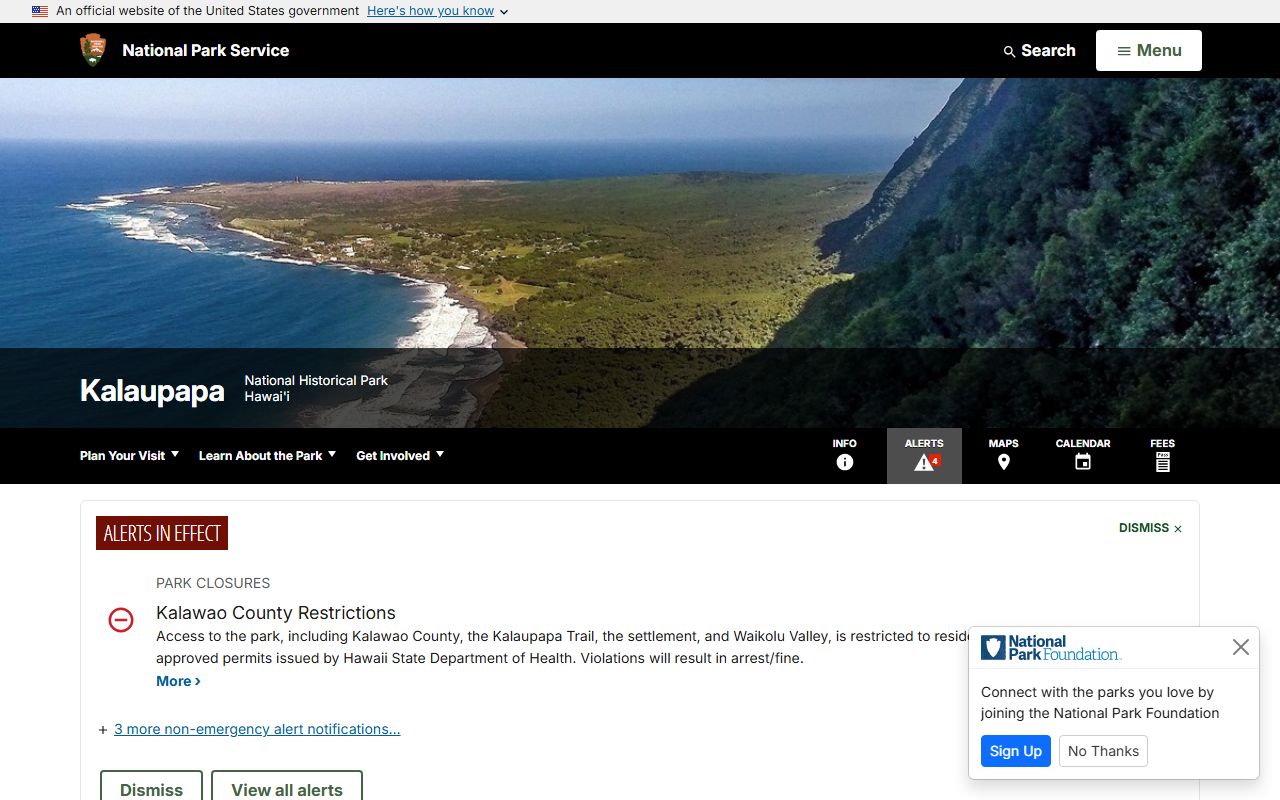
Kalawao County's unusual status as both a national park and a judicial district of Maui County means residents rely on state and Maui County resources for financial services, including unclaimed money searches and claims.
How to Search for Kalawao County Unclaimed Money
To search for unclaimed money tied to a Kalawao County or Kalaupapa address, go to the state portal at unclaimedproperty.ehawaii.gov. Enter your name and review the results. The database covers all property reported to the state under Hawaii Revised Statutes. Property associated with former Kalaupapa residents may appear here if it was reported by a bank, insurer, employer, or other holder. You can search by your own name or by a family member's name if you are looking on someone else's behalf.
The state program is managed by the Department of Budget and Finance. The main program page is at budget.hawaii.gov/finance/unclaimedproperty. The program covers all property reported under Chapter 523A, Hawaii Revised Statutes. Because Kalawao County has no separate finance department, all unclaimed money research starts and ends with the state program. If you need help by phone, call (808) 586-1589. You can also reach staff at the contact page at budget.hawaii.gov/finance/unclaimedproperty/contact-unclaimed-property. The Maui toll-free line at 984-2400 extension 61589 also reaches the state program staff and is the most convenient line for anyone calling from Molokai or Maui.
Since Kalawao is a judicial district of Maui County, some services are handled through Maui County's government at mauicounty.gov. But for unclaimed money specifically, Maui County does not run its own program. Everything routes through the state system. The state program handles all counties and all islands uniformly.
Unclaimed Money Types That Apply to Kalawao County
The types of unclaimed money that can be tied to a Kalawao County address are the same as those anywhere in Hawaii. Bank accounts that go dormant for five years get reported to the state. Utility deposits are turned over after one year. Wages and payroll checks have a one-year dormancy period too. These rules come from HRS Chapter 523A and apply statewide, regardless of county. Any holder operating in or connected to a Kalaupapa address must follow the same rules as holders elsewhere in Hawaii.
Insurance proceeds become reportable after three years when a life insurance policy matures and the beneficiary is not located. Certificates of deposit have a seven-year period. Securities including stocks and dividends also follow the seven-year rule. Traveler's checks have a 15-year dormancy window before becoming reportable. Safe deposit box contents from any Hawaii bank, if left dormant and unclaimed, eventually get turned over to the state program. Real property is not covered. The law only applies to personal property and financial instruments.
Former residents who lived at Kalaupapa years ago, or family members of former patients who may have had accounts or insurance policies, could find funds in the state database. The state holds property indefinitely until it is claimed. There is no deadline for owners or heirs to file.
Claiming Kalawao County Unclaimed Money
Claims for unclaimed money tied to Kalawao County go through the state program at no cost. The owner information page at budget.hawaii.gov/finance/unclaimedproperty/owner-information covers all three claim types: original owner, deceased owner (heir), and business. Each type has specific documentation requirements. For original owner claims, you need a government photo ID and proof of past connection to the address on the account. Claims over $50 must be notarized.
Heir claims for deceased former Kalaupapa residents require additional documentation. Given the unique history of Kalaupapa, family members of former patients may be researching accounts that are many decades old. The state still holds those funds. You may need an Affidavit for Collection of Personal Property of Decedent under HRS 560:3-1201 and 560:3-1202, along with documents showing your relationship to the deceased. Death certificates and proof of family connection are required. Securities claims also require an IRS Form W-9. Mail your claim to P.O. Box 150, Honolulu, HI 96810, or drop it off in person at 250 S. Hotel Street, Room 304, Honolulu, HI 96813.
No finder or locator can charge more than 10% of recovered funds under Section 523A-25. You can always file the claim yourself through the official state program for free. The state does not charge any fee to process or pay out claims. All funds recovered go directly to the rightful owner or heir.
The Hawaii state unclaimed property owner information page is where Kalawao County residents and heirs of former residents go to start the claims process.
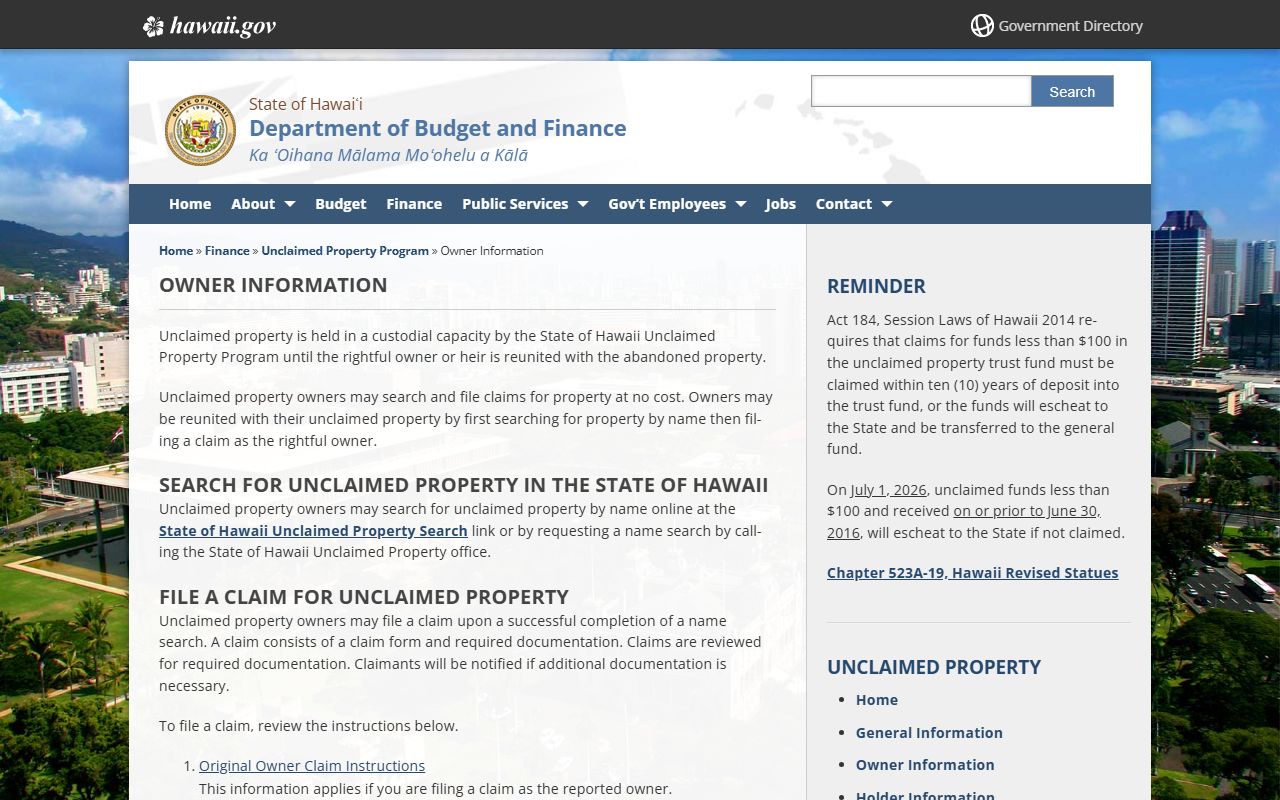
Since Kalawao County has no county-level unclaimed property office, this state page is the single point of contact for all claims tied to the Kalaupapa Peninsula and Kalawao County addresses.
State Law and Kalawao County Unclaimed Property
All unclaimed property in Kalawao County falls under the same state law that governs the rest of Hawaii. Chapter 523A of the Hawaii Revised Statutes sets out the rules for dormancy periods, holder reporting, claim filing, and state custody of unclaimed property. The same law is discussed in plain language at law.justia.com/codes/hawaii/title-28/chapter-523a. No special rules apply to Kalawao County just because of its unusual governmental structure. The state program treats property tied to Kalaupapa the same as property from any other part of Hawaii.
Holders who operate in or near Kalawao County, such as any bank or financial institution that has accounts for Kalaupapa residents, must comply with the same reporting rules as other holders statewide. Annual reports are due by November 1. Electronic filing in NAUPA Standard Electronic File Format is required. The NAUPA organization's Hawaii reporting page at unclaimed.org/reporting/hawaii has technical guidance on the file format. The state holder information page at budget.hawaii.gov/finance/unclaimedproperty/holder-information covers the full process.
One important deadline affects older small claims. Under Act 184, funds under $100 that the state received on or before June 30, 2016, will permanently escheat on July 1, 2026. Any Kalawao County resident or heir of a former resident who has a small-dollar claim reported years ago should search and file before that date to avoid losing access to those funds permanently.
Communities in Kalawao County
Kalawao County has no cities with individual pages on this site. The county's only community is Kalaupapa on the Kalaupapa Peninsula. Access is restricted. Residents and former residents of Kalaupapa use the state unclaimed property portal directly at unclaimedproperty.ehawaii.gov. Family members of former Kalaupapa patients can also search using the name of the person they are researching.
Nearby Counties
Kalawao County is administered as a judicial district of Maui County. The other Hawaii counties also use the same state unclaimed property system and have their own pages with local resource details.