
Kauai County Unclaimed Money
Kauai County, which includes the islands of Kauai and Niihau, is covered by the Hawaii Unclaimed Property Program run by the state Department of Budget and Finance. If you have lived or worked on Kauai, you may have unclaimed money held by the state. Former residents who moved to the mainland or another island may also have old accounts sitting in the database. Searching is free. You just need your name and a few minutes at the state's official portal.
Kauai County Overview
Kauai County Unclaimed Money Search
Kauai County residents can search for unclaimed money at the state portal: unclaimedproperty.ehawaii.gov. Enter your name and browse the results. The system pulls all property the state holds on your behalf, including funds tied to Kauai and Niihau addresses. You can search for a business by name as well. No account or login is required. No fee is charged at any step.
The state publishes a county-specific notice document for Kauai. This PDF, available at budget.hawaii.gov, lists unclaimed property notices required under Chapter 523A, Hawaii Revised Statutes. If you spot your name there, it means the state has property in your name and is trying to reach you. Go to the owner information page at budget.hawaii.gov/finance/unclaimedproperty/owner-information to start the claim process.
Kauai residents can call the state program toll-free. Dial 274-3141 and enter extension 61589. This line connects you to state unclaimed property staff in Honolulu. The office is open Monday through Friday, 7:45 AM to 4:30 PM Hawaii Standard Time, except state holidays. You can also reach staff by phone at (808) 586-1589 if calling from outside Kauai, or use the online contact form at budget.hawaii.gov/finance/unclaimedproperty/contact-unclaimed-property.
The Kauai County Department of Finance UIPA profile lists the county's finance department contact details and public records request information.
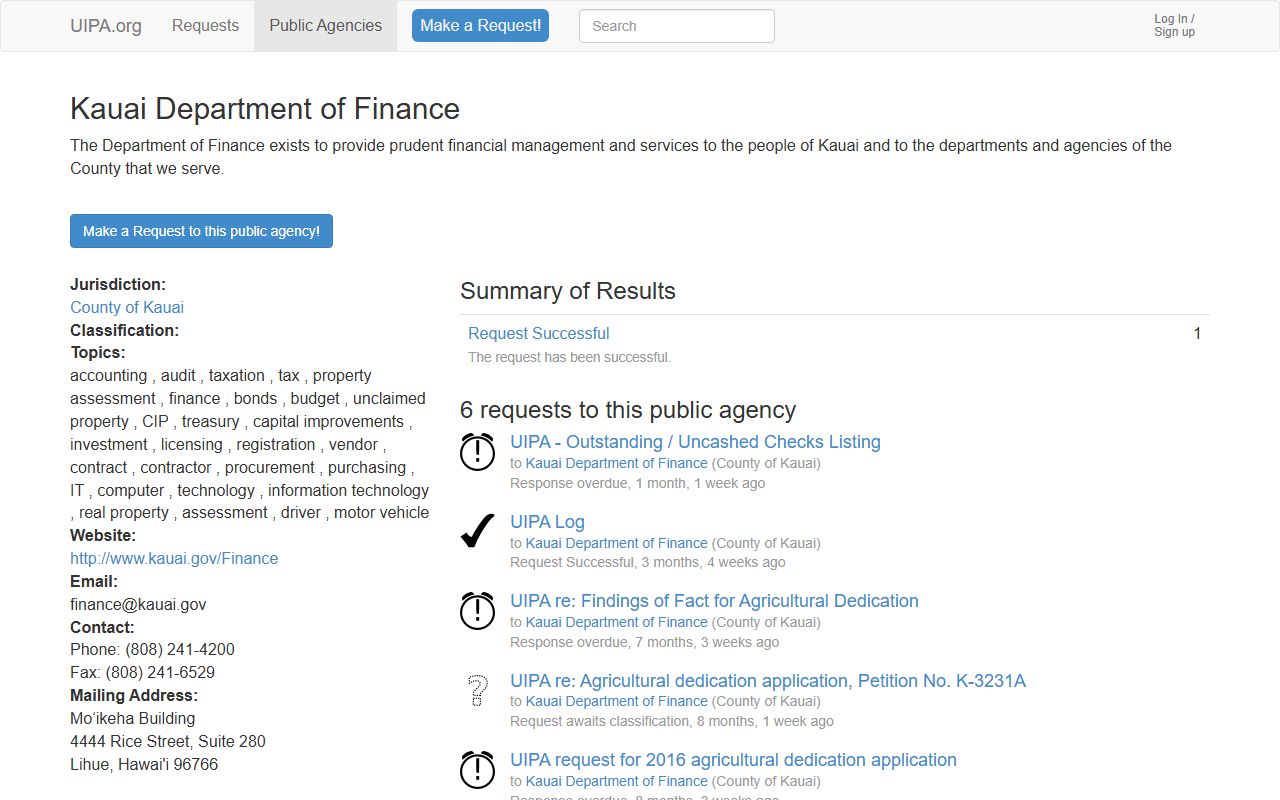
The county finance department manages Kauai's financial operations but does not run its own unclaimed property database. All Kauai County unclaimed money goes through the state program.
Kauai County Department of Finance
The Kauai County Department of Finance is based at the Mo'ikeha Building, 4444 Rice Street, Suite 280, Lihue, Hawaii 96766. Call them at (808) 241-4200 or fax (808) 241-6529. You can also reach the department by email at finance@kauai.gov or visit their web page at kauai.gov/Government/Departments-Agencies/Finance. Director Chelsie Sakai leads the department. Deputy Director Michelle L. Lizama oversees day-to-day operations.
The department covers motor vehicles, real property tax, transient accommodations tax, purchasing, accounting, information technology, and treasury functions. One notable fact about Kauai County is that personal property is not taxed. Only real property is subject to county tax. Online payment options are available for real property taxes, motor vehicle registration, and sewer bills. A Financial Transparency Portal is also available through the county website. None of these county functions overlap with the state unclaimed property program. For unclaimed money, the state program is the only channel.
For real property records on Kauai, you can search the qPublic portal at qpublic.net/hi/kauai. This gives you ownership and assessment information for Kauai County parcels. It is separate from the unclaimed money system, but it can help if you are tracing financial records that involve real property on the island.
Types of Unclaimed Money in Kauai County
Bank accounts are the most frequently reported type of unclaimed money from Kauai County. After five years without owner activity, banks must report dormant checking and savings accounts to the state. Certificates of deposit follow a seven-year window. Many Kauai residents who moved away over the years may have left accounts open that they forgot about. Those funds flow through to the state program once the dormancy period runs out and the bank can no longer reach the owner.
Insurance proceeds are another big category. When a life insurance policy matures and the insurer cannot find the beneficiary for three years, they must turn the money over to the state under HRS Chapter 523A. Utility deposits have just a one-year dormancy window. If you paid a deposit for electric, water, or phone service on Kauai and never got it back after moving, it may be in the state database now. Wages and payroll checks that went uncashed also fall under the one-year rule. Employers across Kauai are required to report these each year by November 1.
Stock dividends and securities have a seven-year dormancy period. Traveler's checks have the longest hold at 15 years. Money orders and official bank checks reach the five-year mark before they must be reported. Safe deposit box contents from Kauai banks also end up with the state after the dormancy period runs out. Real estate is not included in the unclaimed property program. Only personal property and financial instruments qualify.
Questions about dormant accounts specifically can be directed to the Hawaii Division of Financial Institutions. Their FAQ page at cca.hawaii.gov/dfi/dormant-account-faqs explains how banks handle dormant accounts before turning them over to the state.
The Kauai County Finance Department page at kauai.gov provides access to county financial services including online payment options and department contact information.
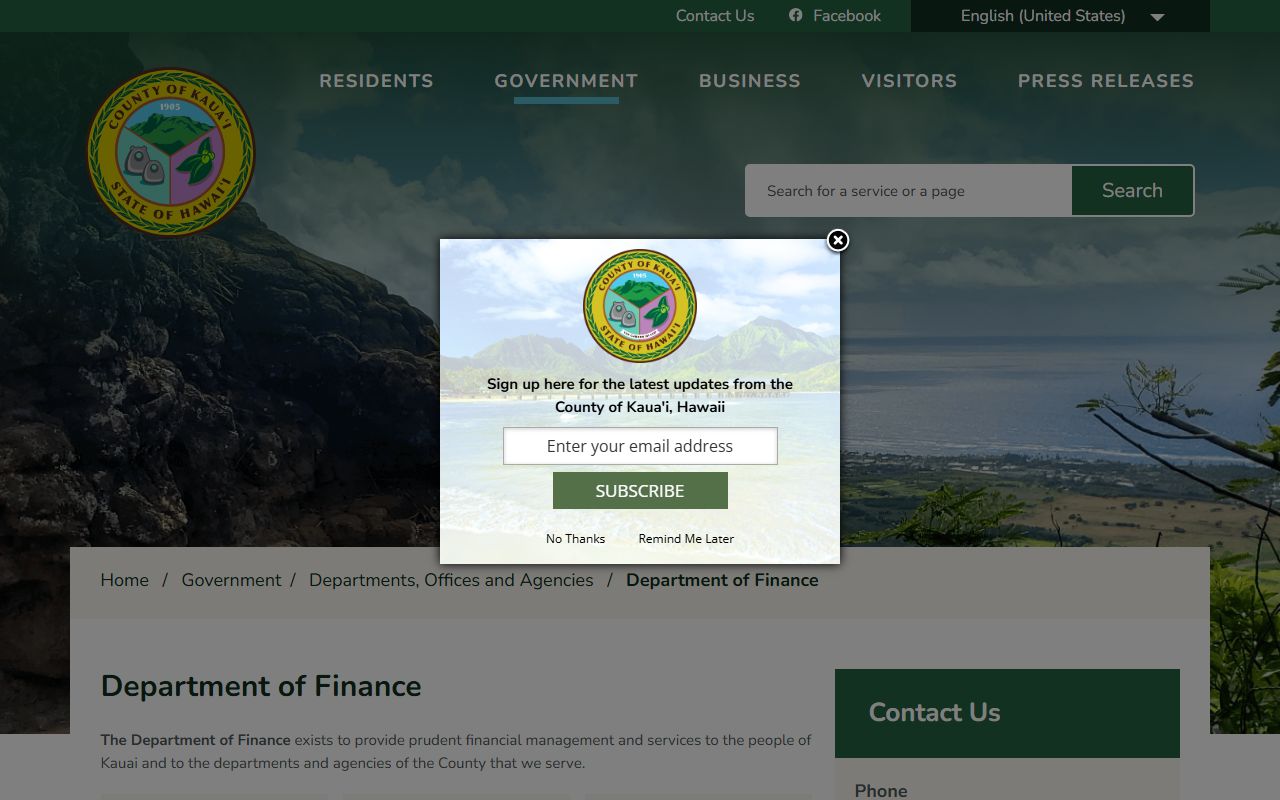
While the county finance page covers taxes and vehicle registration rather than unclaimed money, it is the right starting point for financial questions tied specifically to Kauai County government operations.
How to Claim Kauai County Unclaimed Money
The claim process for Kauai County unclaimed money runs through the state program at no cost to you. Start at the owner information page at budget.hawaii.gov/finance/unclaimedproperty/owner-information. Choose the claim type that fits your case: original owner, deceased owner (heir), or business. Each type has different documentation requirements that are listed on that page.
Original owner claims need a government photo ID and proof of your connection to the address on the account. Claims over $50 must be notarized before submission. For heir claims on a deceased person's funds, you may need an Affidavit for Collection of Personal Property of Decedent under HRS 560:3-1201 and 560:3-1202. Death certificates and documents showing your relationship to the deceased are also required. Securities claims always require an IRS Form W-9 regardless of the claim type. Mail completed claims to P.O. Box 150, Honolulu, HI 96810, or visit in person at No. 1 Capitol District Building, 250 S. Hotel Street, Room 304, Honolulu.
No one should charge you to claim your own money. If a locator or finder contacts you and offers to recover your funds for a fee, the state caps that fee at 10% of the recovered amount under Section 523A-25. You are always free to file the claim yourself through the official state program at no charge. There is also no time limit on filing. Property stays in the state trust fund indefinitely until the owner or heir claims it.
Kauai real property records are accessible through the Kauai Real Property Tax search via qPublic, which shows ownership and assessment data for parcels across the island.
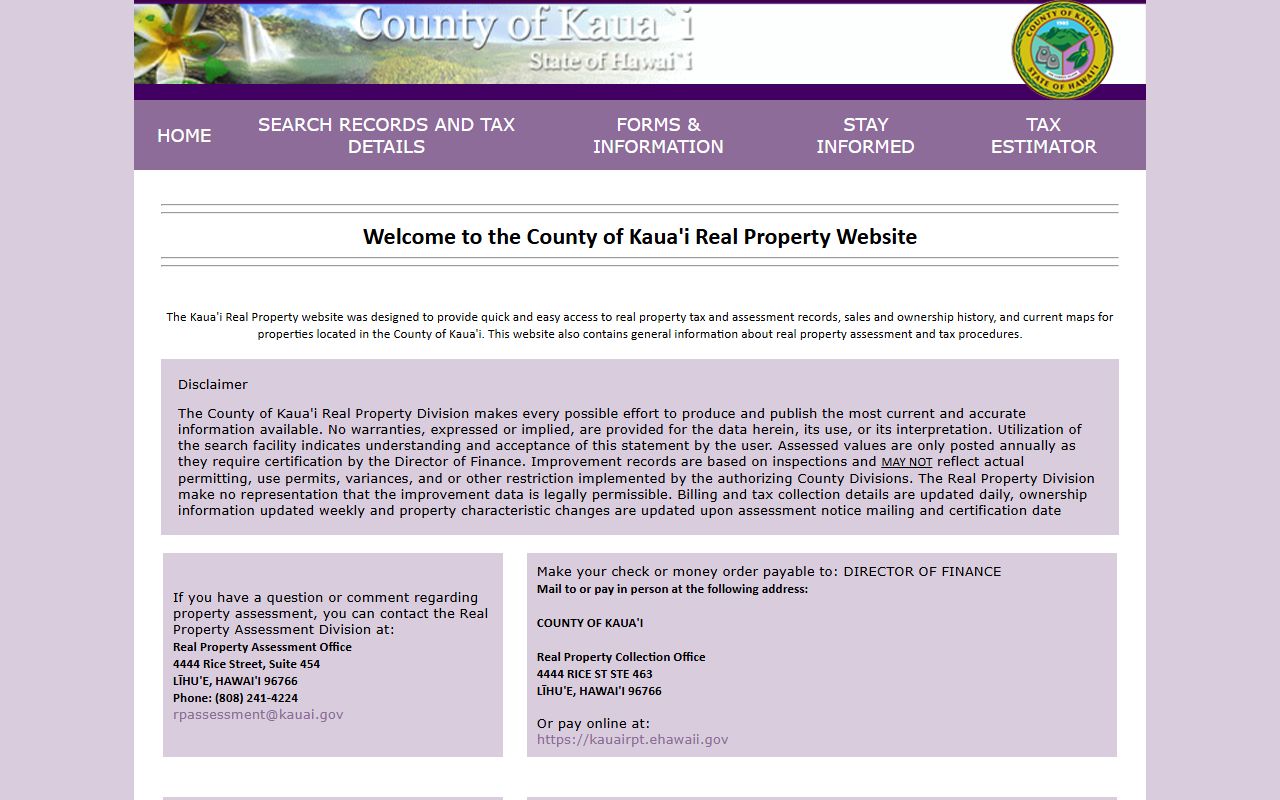
This portal is not part of the unclaimed money program, but property owners on Kauai may find it useful when cross-referencing financial records tied to specific parcels or past addresses on the island.
Holder Obligations in Kauai County
Any business or organization in Kauai County that holds money or property belonging to another person must report that property to the state program once the dormancy period is reached. This includes banks, credit unions, employers, utilities, insurance companies, and other businesses. Annual reports are due by November 1 each year. All reports must use the NAUPA Standard Electronic File Format. Paper submissions are not accepted under state rules.
The state holder information page at budget.hawaii.gov/finance/unclaimedproperty/holder-information covers the full reporting process. NAUPA's Hawaii resource at unclaimed.org/reporting/hawaii provides additional guidance on the electronic format requirements. Penalties can apply to holders that fail to file on time or that fail to file at all. Small businesses with just a handful of dormant accounts still need to comply if they hold another person's money past the applicable dormancy period.
Note: Under Act 184, funds under $100 that the state received on or before June 30, 2016, will permanently escheat to the state on July 1, 2026. Kauai County residents with old small-balance claims should check the database and file before that cutoff.
Cities in Kauai County
No cities in Kauai County currently have individual unclaimed money pages on this site. Communities on Kauai and Niihau include Lihue, Kapaa, Waimea, Princeville, Hanapepe, and Koloa. Residents of all these communities use the same state search portal and claim process. Go to unclaimedproperty.ehawaii.gov to search regardless of which town you live in or used to live in on Kauai.
Nearby Counties
Hawaii's other counties also have unclaimed money resources through the same statewide program. Find local contact info and search details on each county's page.