
Access Kailua Unclaimed Money
Kailua residents on the windward coast of Oahu can search for unclaimed money through the Hawaii state unclaimed property program and the City and County of Honolulu escheated checks database. The state program, run by the Department of Budget and Finance under HRS Chapter 523A, holds funds from banks, insurers, utilities, and other businesses that lost touch with account holders. The city program covers undelivered city-issued checks. Both are free to search and free to claim. This page walks through both, what you need to file, and how Hawaii's unclaimed property law protects your right to recover your funds.
Kailua Overview
Kailua Unclaimed Money Database Search
Start your search at the Hawaii state portal: unclaimedproperty.ehawaii.gov. The search is by name. Enter your full name, and the system returns any matching unclaimed property records in the state database. Kailua is a census-designated place in Honolulu County, and the statewide program covers all Hawaii counties. You can also search under prior names, maiden names, or business names. There is no cost to search.
Kailua residents also benefit from the Honolulu city escheated checks program. That database is at honolulu.gov/bfs/escheated-checks. It holds city-issued checks from 2022 through 2025 that were never cashed. You search by payee name, check amount, or check number. This is a different system from the state program. The state holds money from private sector businesses. The city holds checks it issued directly. Check both.
The state office is at 250 S. Hotel Street, Room 304, Honolulu. From Kailua, you can reach the office by driving through the Pali or Wilson tunnels. The phone number is (808) 586-1589. Hours are Monday through Friday, 7:45 a.m. to 4:30 p.m. HST. You can also mail questions to P.O. Box 150, Honolulu, HI 96810. The program overview is at budget.hawaii.gov/finance/unclaimedproperty.
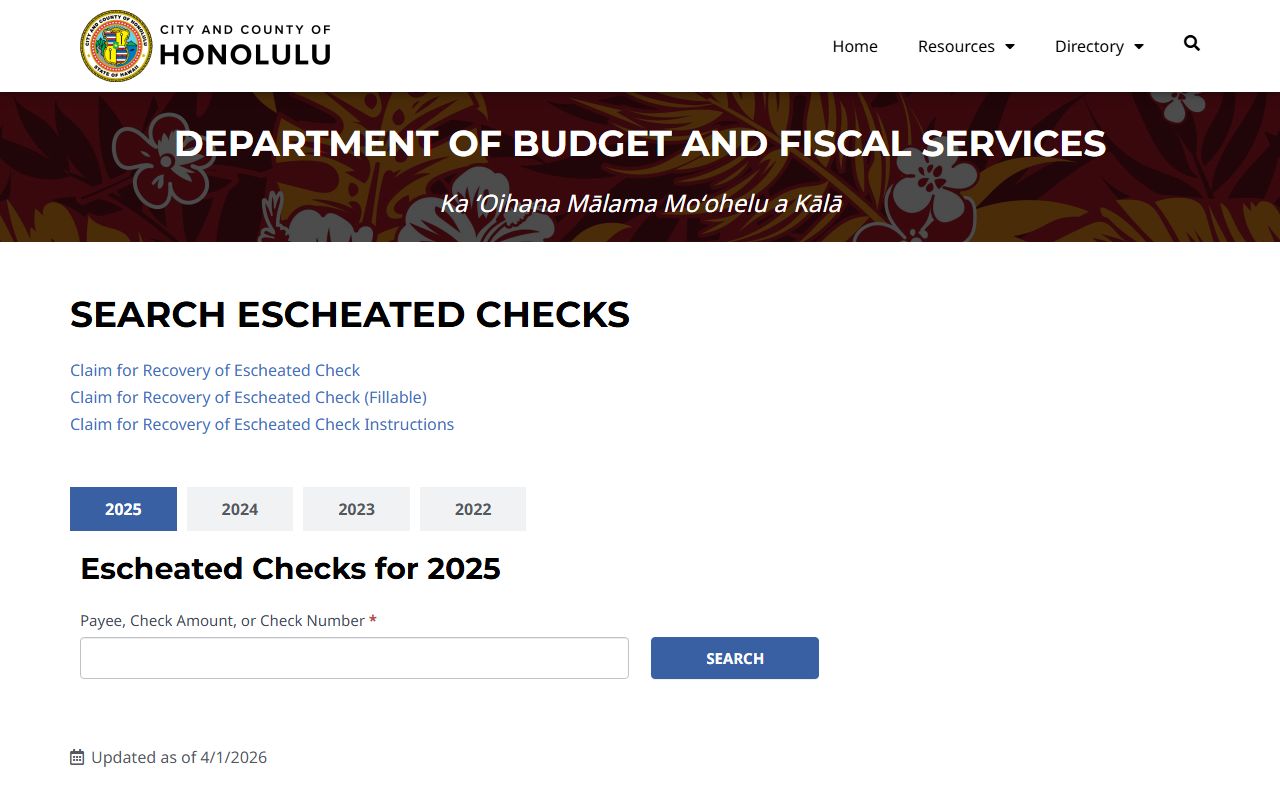
The Honolulu escheated checks program lets Kailua residents search for undelivered city-issued checks by name or check details and download a claim form directly from the site.
What Kailua Residents Should Know
Property ends up in the state's hands when a financial institution or company can no longer reach the owner. Changed addresses are the most common cause. Banks, insurance companies, utilities, and employers all lose track of people over time. Hawaii law requires them to try to reach owners before turning the property over to the state. Once property is transferred, the state holds it as custodian. It does not keep the money permanently. Most claims can be filed at any time.
Kailua residents may have unclaimed property from old bank accounts, certificates of deposit, payroll checks, insurance policy proceeds, utility deposits, stock dividends, or the contents of safe deposit boxes. If you have moved frequently, worked several jobs, or changed banks, the odds that something is sitting out there go up. Dormancy periods run from one year for wages to fifteen years for traveler's checks. Most bank accounts go dormant after five years of no activity and no contact with the owner. CDs go dormant after seven years from maturity.
One area windward Oahu residents sometimes overlook is life insurance. Many people have old policies from employers or associations that paid out after death but could not locate the beneficiary. Three years after a life insurance policy matures, the proceeds are reported to the state. If someone in your family passed away and you were named as a beneficiary on an old policy, it is worth checking.
Note: Under Act 184, property under $100 received by the state on or before June 30, 2016, will permanently escheat to the state on July 1, 2026. If you have any reason to think small amounts exist under your name from old accounts, search before that date.
Filing a Kailua Unclaimed Money Claim
Once you find a match in the state database, the next step is to file a claim. You can do this online through the state portal or by mail. Three claim types exist: original owner, deceased owner (heirs), and business. The original owner process is the most straightforward. You need a government-issued photo ID and some proof of ownership, such as an old statement, a former address on file with the institution, or a policy number.
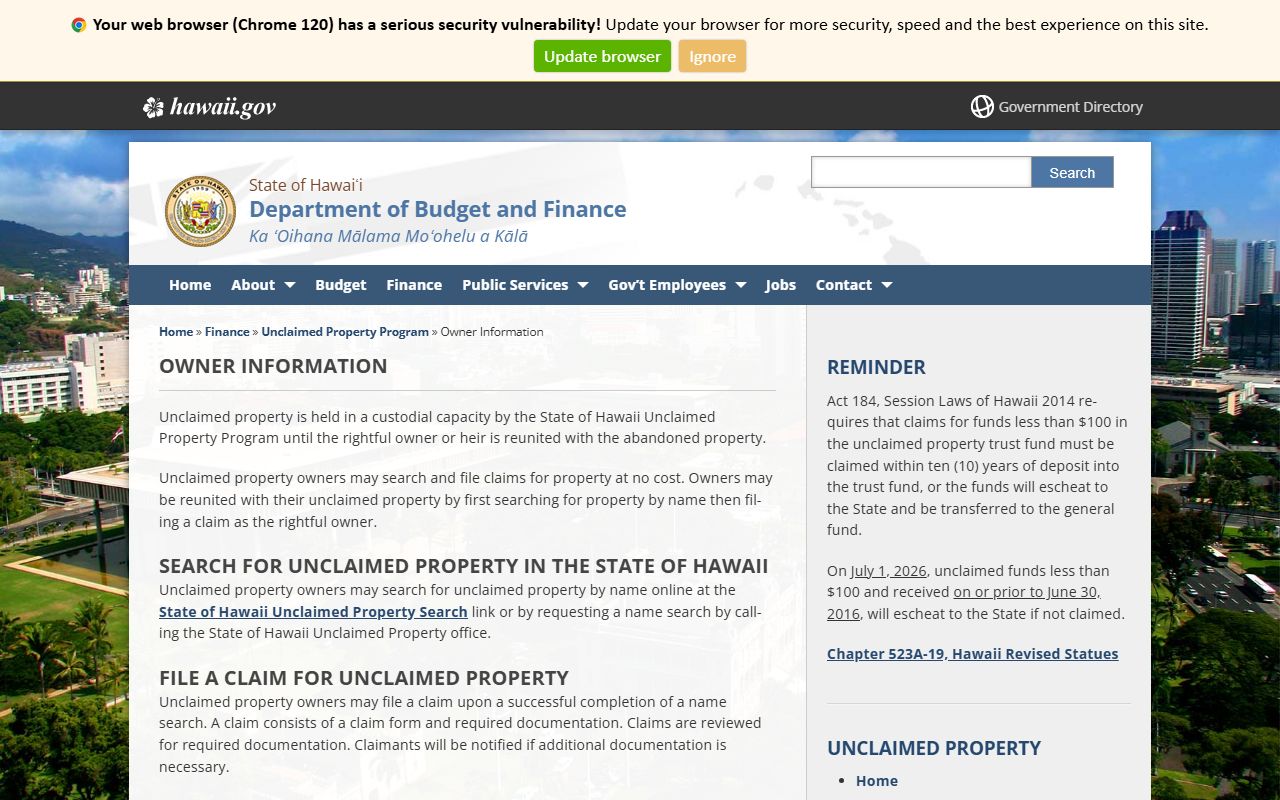
The owner information page at budget.hawaii.gov details what each claim type requires and how to submit documentation for Kailua residents filing a state unclaimed money claim.
Claims over $50 require notarization. That is a quick process. Any notary public can handle it. UPS stores, banks, and some libraries in Kailua and nearby Kaneohe offer notary services. Securities or investment property claims require an IRS Form W-9 in addition to the standard claim form. Send completed claims to P.O. Box 150, Honolulu, HI 96810, or deliver them in person to 250 S. Hotel Street, Room 304. If you have questions before filing, the state contact page is at budget.hawaii.gov/finance/unclaimedproperty/contact-unclaimed-property.
Heir claims require more paperwork. If you are filing for a deceased Kailua resident, you need an Affidavit for Collection of Personal Property of Decedent, a certified death certificate, and documentation of your relationship to the owner. Hawaii courts and notary offices can help with affidavit preparation. The state processes these claims in the same way as original owner claims once the documents are verified.
Hawaii Unclaimed Property Laws and Resources
Hawaii's unclaimed property law is found at HRS Chapter 523A. The law sets dormancy periods, requires holders to report and turn over property, establishes the state's duty to hold funds indefinitely, and governs how owners and heirs can file claims. It also caps finder fees at 10 percent of the property value under Section 523A-25. You are never required to use a finder service. The state search is free and the claim is free.
A more readable version of the statute is available at Justia's Hawaii Chapter 523A page. For questions about bank accounts going dormant, the Hawaii Division of Financial Institutions has a clear dormant account FAQ page. The National Association of Unclaimed Property Administrators has a Hawaii-specific page with background on how the state program fits into the national framework.
For the city program, the Honolulu Department of Budget and Financial Services is at honolulu.gov/bfs. The Treasury Division handles escheated checks and is located at Honolulu Hale, 530 South King Street, Room 115. Email the Treasury Division at bfstreasmailbox@honolulu.gov. Claim forms for city checks are at honolulu.gov/bfs/financial-forms. The Treasury Division page is at honolulu.gov/bfs/treasury-division.
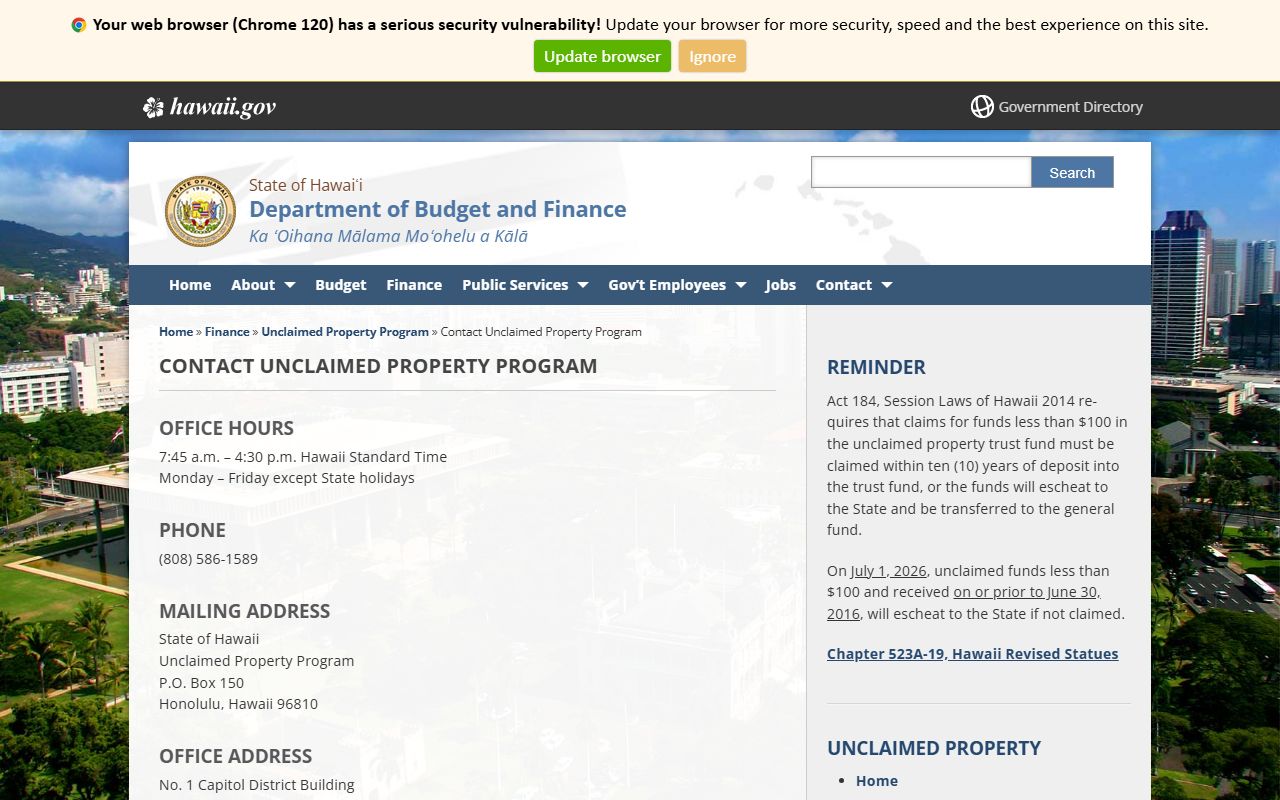
The state contact page at budget.hawaii.gov is where Kailua residents can reach the Unclaimed Property Program by phone or mail for help with searches, claims, or documentation questions.
Honolulu County Unclaimed Money Resources
Kailua is part of Honolulu County. The county page brings together state and city unclaimed money resources for all Honolulu County residents, with statute references, contact details, and claim filing guidance in one place.
Nearby Cities
These Honolulu County communities near Kailua use the same Hawaii state and city unclaimed money programs.