
Kaneohe Unclaimed Money Search
Kaneohe residents can search for unclaimed money through two programs. The Hawaii Department of Budget and Finance runs the state unclaimed property program, which holds dormant bank accounts, uncashed checks, insurance refunds, and other assets turned over by businesses across Oahu. Honolulu city also keeps a separate database of escheated checks that includes payees from Kaneohe and the rest of windward Oahu. Both searches are free. You do not pay anything to look up records or file a claim.
Kaneohe Overview
Kaneohe Unclaimed Money Search Portals
Kaneohe is a census-designated place on the windward coast of Oahu, fully within Honolulu County. That means two unclaimed money databases apply here. First, the Hawaii state program at unclaimedproperty.ehawaii.gov lets you search all property reported to the state. The state system holds assets from banks, credit unions, insurance companies, utilities, and other businesses that lost contact with the owner. You can search by name or by property ID. Results show the holder name, property type, and reported amount when known.
The second database is the Honolulu city escheated checks program. The city's Bureau of Budget and Fiscal Services maintains a list of uncashed checks issued by the city that were never cashed. You can look up checks by payee name, check amount, or check number. Records go back to 2022. The search page is at honolulu.gov/bfs/escheated-checks/. If you find a check with your name, you fill out the Claim for Recovery of Escheated Check form right on that page. It is fillable online. You should run both searches because a record in one system does not appear in the other.
The lead-in screenshot below comes from the Honolulu escheated checks page. The city Treasury Division manages this fund. Their office is at 530 South King Street, Room 115.
The Honolulu Bureau of Budget and Fiscal Services hosts the escheated checks search, which covers windward Oahu residents including Kaneohe.
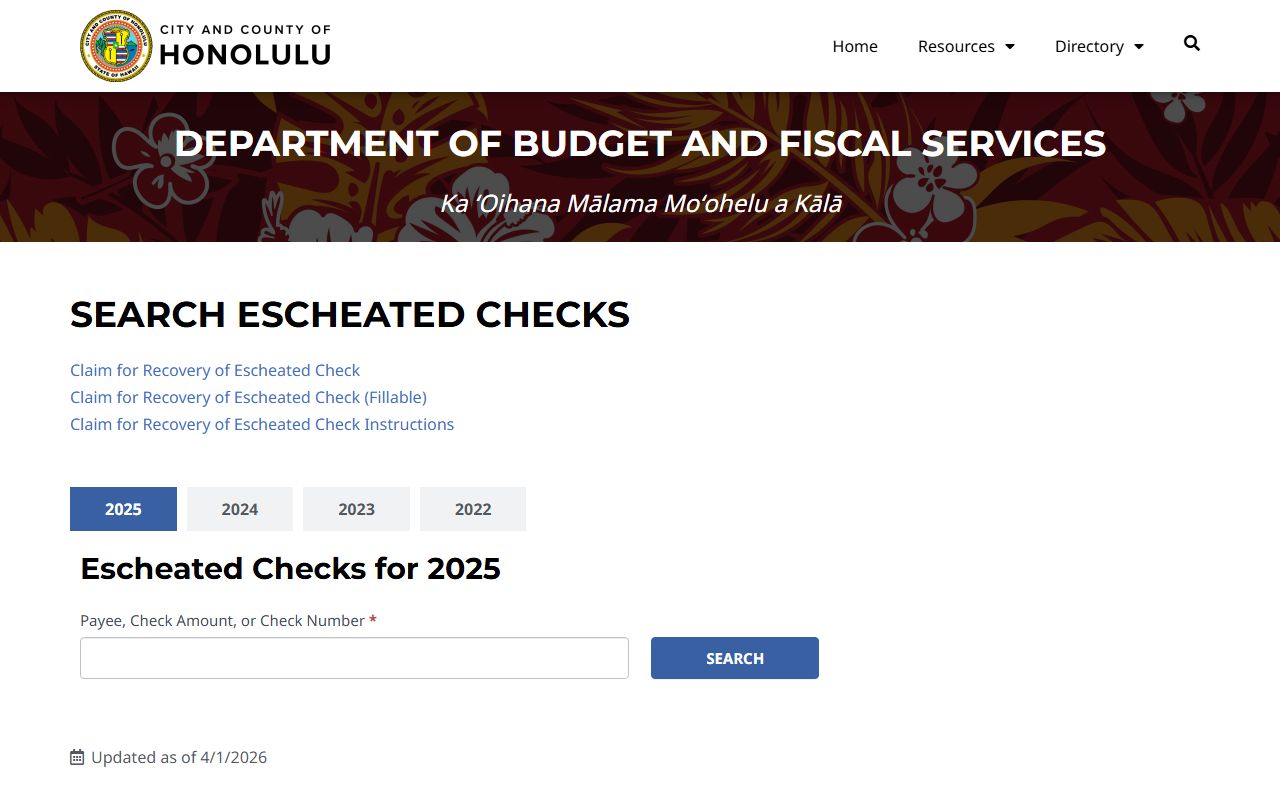
The search form lets you enter a payee name, check amount, or check number to locate unclaimed city funds tied to Kaneohe addresses.
Unclaimed Money Types in Kaneohe
The state program collects many kinds of unclaimed money. Bank accounts are the most common. A checking or savings account goes dormant after five years without owner contact. Certificates of deposit become unclaimed after seven years. Life insurance proceeds are turned over to the state after three years if the insurer cannot locate the beneficiary. Wages and payroll checks become unclaimed after just one year. That is the shortest dormancy period in the program.
Utility deposits are another type Kaneohe residents find often. When you move and your electric or water utility cannot locate you to send a refund, that deposit eventually goes to the state. Stock dividends and shares work the same way. A brokerage or transfer agent that loses contact with a shareholder must report those securities to Hawaii after three years. The state holds the cash value or, in some cases, the actual shares. Traveler's checks have the longest dormancy period at 15 years before they are turned over.
Other types include safe deposit box contents, court-ordered refunds, vendor overpayments, and insurance premium refunds. Any business operating in Hawaii that holds money or assets belonging to someone they cannot reach is required under Hawaii Revised Statutes Chapter 523A to report and remit those funds to the state program.
Note: The state holds property indefinitely. There is no deadline to file your claim.
How to Claim Kaneohe Unclaimed Money
Claiming unclaimed money as a Kaneohe resident starts with a search. Go to unclaimedproperty.ehawaii.gov and enter your name. Try variations of your name and maiden names if applicable. Also search for deceased family members. The state holds property for heirs too. If you find something, click on the record and start the claim from there. The owner information page at budget.hawaii.gov explains what documents to gather before you file.
Claims under $50 are straightforward. You fill out the online claim form, provide your identifying information, and submit. Claims over $50 need notarization. You sign the claim form in front of a notary public who stamps and signs it. Notary services are available at banks, credit unions, and UPS stores. Some Kaneohe libraries also keep notary hours. After you submit, the state reviews the claim. Most are processed within 90 days.
If you are claiming as an heir for a deceased owner, you need extra documents. The state requires an Affidavit for Collection of Personal Property of Decedent under Hawaii Revised Statutes Sections 560:3-1201 and 560:3-1202. You also need proof of your relationship to the deceased and a copy of the death certificate. Securities claims require a signed IRS Form W-9 so the state can report any taxable distributions.
The image below shows the state owner information page where claimants find the full list of required documents for each claim type.
The Hawaii state owner information page outlines documents needed for original owner claims, heir claims, and business claims.
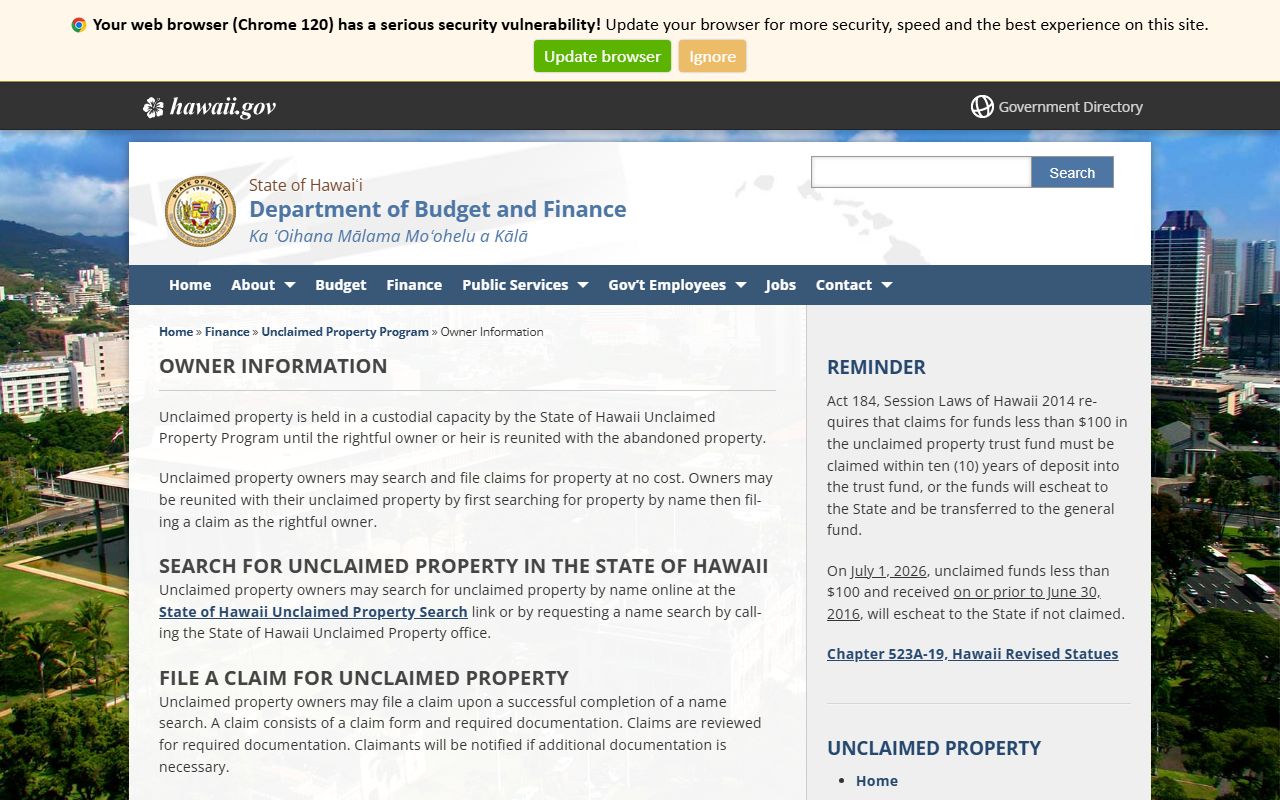
Three claim types are available: Original Owner for living claimants, Deceased Owner for heirs, and Business for companies reclaiming assets.
Honolulu County Resources for Kaneohe
Kaneohe falls within Honolulu County, the only county on Oahu. The Honolulu Bureau of Budget and Fiscal Services at honolulu.gov/bfs/ handles city financial programs including the escheated checks database. The Treasury Division within that bureau manages the list. Financial claim forms for city programs are available at honolulu.gov/bfs/financial-forms/. If you need to visit in person, Treasury is at 530 South King Street, Room 115, in downtown Honolulu. The office is open Monday through Friday during regular business hours.
For state program questions from Kaneohe, you can call the Hawaii Unclaimed Property Program directly at (808) 586-1589. Their physical office is at 250 S. Hotel Street, Room 304, Honolulu, HI 96813. Mailing address is P.O. Box 150, Honolulu, HI 96810. Office hours are Monday through Friday, 7:45 a.m. to 4:30 p.m. HST. You can also reach the program through the contact page at budget.hawaii.gov.
Note: Both the state and city contact offices are in Honolulu, not in Kaneohe itself, but all claims can be handled by phone, mail, or online without traveling downtown.
Kaneohe Unclaimed Money Laws
Hawaii's unclaimed property law is found in Hawaii Revised Statutes Chapter 523A. This law sets the dormancy periods for each type of property, the reporting rules for holders, and the process for state custody. It also covers how owners and heirs can file claims and what the state must do to try to locate owners before property is reported. The law applies statewide, so it covers all Kaneohe residents and businesses.
Under Section 523A-25 of the statute, finder fees are capped at 10 percent of the claimed amount. That means if someone offers to locate and recover your unclaimed money for a fee, they cannot legally charge you more than 10 percent. But you can always search and claim directly through the state website at no cost. There is no reason to pay a finder unless you prefer someone else to handle the paperwork.
Act 184 introduced an important deadline. Any unclaimed funds under $100 that were received by the state on or before June 30, 2016, will permanently escheat to Hawaii on July 1, 2026. After that date, those small-dollar claims cannot be recovered. If you think you may have old unclaimed money from before 2016, run a search now. For dormant account questions specific to banks and credit unions, the Division of Financial Institutions at cca.hawaii.gov has a detailed FAQ.
Honolulu County Unclaimed Money
Kaneohe is part of Honolulu County. All state unclaimed property for windward Oahu is managed through the same program that covers the rest of the county. For more on county-level resources and office details, visit the Honolulu County page.
Nearby Cities
These communities near Kaneohe also use the same state and Honolulu city unclaimed money programs.