
Makakilo Unclaimed Money Search
Makakilo residents can search for unclaimed money through two programs: the Hawaii state unclaimed property database managed by the Department of Budget and Finance, and the City and County of Honolulu escheated checks system. Both searches are free, and filing a claim costs nothing. This page covers how to search each program, what kinds of property the state holds for Makakilo residents, and what documents you need to get your money back.
Makakilo Overview
Makakilo Unclaimed Money Search Options
The Hawaii state unclaimed property search portal is free and open to anyone. Go to unclaimedproperty.ehawaii.gov and type in your full name or business name. The system checks the state database and shows any matching property. Makakilo is a census-designated place in west Oahu, and residents here may have property reported under prior addresses, maiden names, or former employers. Try a few variations when you search. The database pulls records from across Hawaii, not just Oahu.
Makakilo falls within the City and County of Honolulu, so residents should also check the Honolulu city escheated checks database. This program covers checks the city issued that were never cashed. It is separate from the state program. Search it at honolulu.gov/bfs/escheated-checks. You can look by payee name, check number, or check amount. The database goes back to 2022. Run both searches, because funds held by the city will not appear on the state portal.
The state office is in Honolulu at 250 S. Hotel Street, Room 304, Honolulu, HI 96813. Phone is (808) 586-1589. Staff are available Monday through Friday, 7:45 a.m. to 4:30 p.m. HST. Mail questions to P.O. Box 150, Honolulu, HI 96810. The main program page is at budget.hawaii.gov/finance/unclaimedproperty.
The Honolulu escheated checks program page lets Makakilo residents search for city-issued checks that were never cashed, covering payments from 2022 through 2025 issued by the City and County of Honolulu.
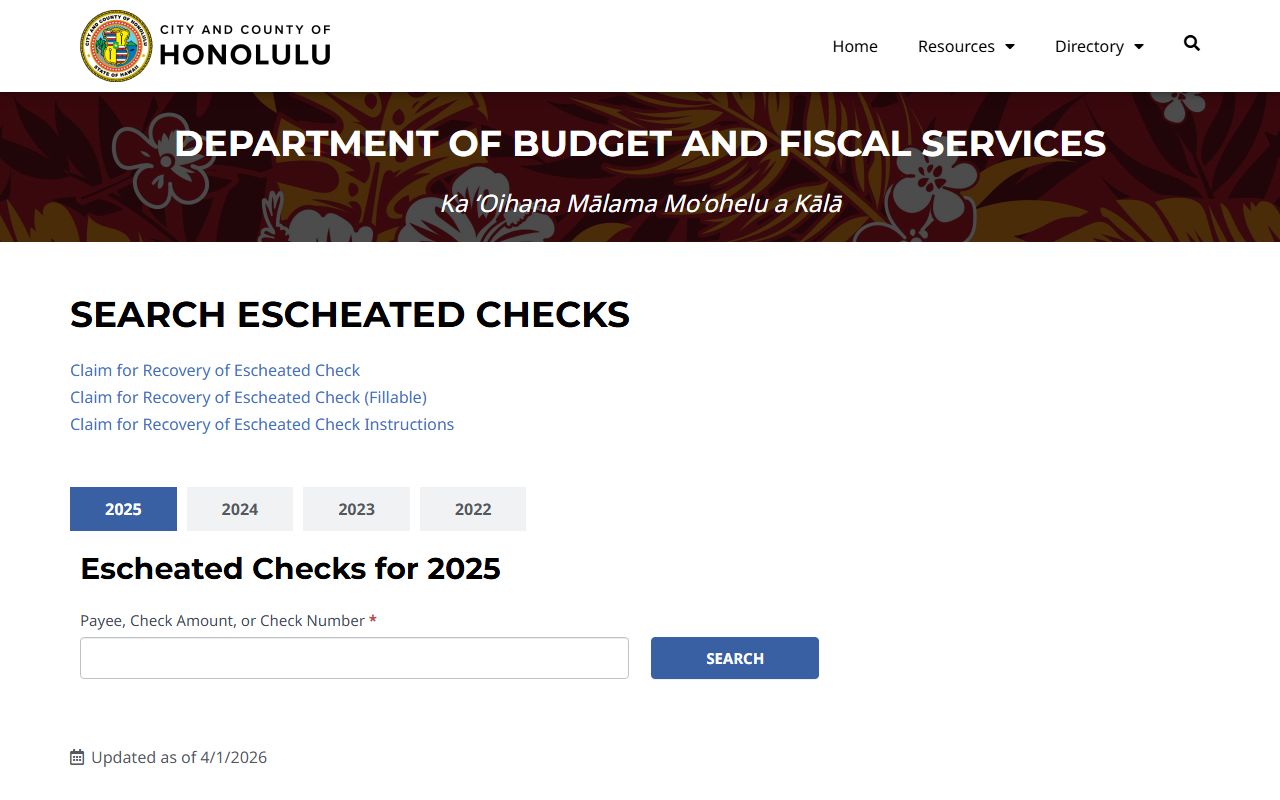
The escheated checks database is separate from the state program. Makakilo residents who may have received city payments in prior years should search it as a second step.
Unclaimed Property Types for Makakilo Residents
Many types of property can end up in the state's unclaimed fund. Banks and credit unions report dormant accounts. Insurance companies report unclaimed policy proceeds. Employers report uncashed payroll checks. Utility companies report deposits that were never returned. Courts and government agencies report funds they hold on behalf of people they can no longer reach. All of this goes to the state after the dormancy period expires. The state holds it indefinitely and waits for the owner to come forward.
Dormancy periods vary by property type. Wages and salary checks go dormant after one year. Life insurance proceeds go dormant after three years. Savings and checking accounts go dormant after five years. Certificates of deposit go dormant after seven years. Traveler's checks have the longest period at fifteen years. A Makakilo resident who moved, changed banks, or stopped getting mail at an old address could easily have funds sitting in the state system that have been there for years.
Business owners in Makakilo should check too. If you ran a business that is now closed or changed its registered address, the state may hold funds under the business name. Search under both your personal name and any business names you have used.
Note: Act 184 created a permanent escheat deadline for certain small funds. Property under $100 received by the state on or before June 30, 2016, will permanently transfer to the state on July 1, 2026. If you think you have small amounts out there from years ago, search now.
Filing a Claim for Makakilo Unclaimed Money
Claiming unclaimed money in Hawaii is free. The state does not charge you to search or to file. If a third party contacts you offering to recover your funds for a fee, Hawaii law limits that fee to 10 percent of the property value under Section 523A-25 of the Hawaii Revised Statutes. You can always go straight to the state and file at no cost. There is no reason to pay someone else to do something the state lets you do for free.
Three types of claims exist. Original owners file for property held under their own name. If the owner is deceased, an heir files a deceased owner claim. That type of claim requires an Affidavit for Collection of Personal Property of Decedent. The affidavit comes from Hawaii Revised Statutes sections 560:3-1201 and 560:3-1202. You also need a copy of the death certificate and documents showing your relationship to the deceased. The third type covers business claims. Each type has its own form and set of required documents. The owner information page lists what each claim needs.
Claims over $50 require notarization. All claimants need a copy of a government-issued photo ID. You also need proof that connects you to the property, such as an old bank statement, a policy number, or proof of a prior address. Securities claims require IRS Form W-9. Once your documents are ready, mail them to P.O. Box 150, Honolulu, HI 96810, or bring them in person to the Hotel Street office.
The state owner information page details each claim type and what you need to submit. Makakilo residents filing claims should review that page before gathering documents.
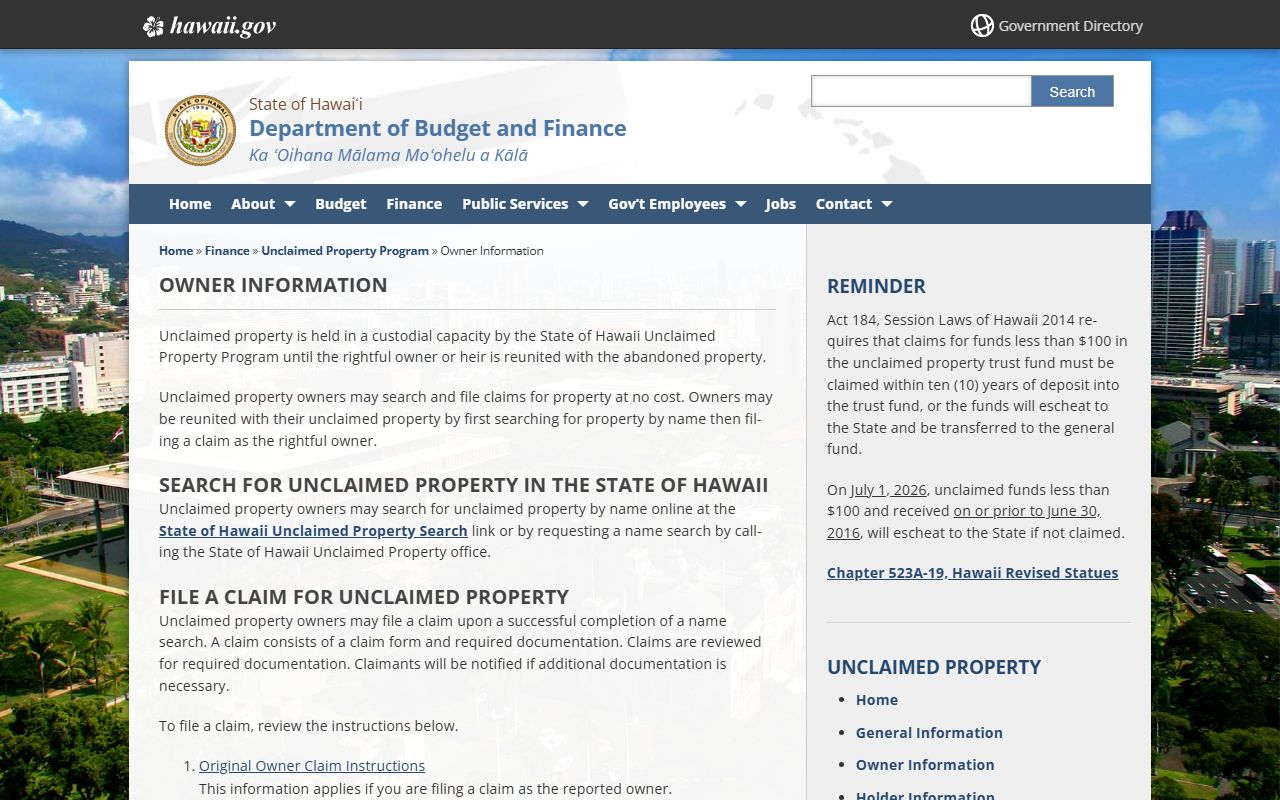
The owner information page at budget.hawaii.gov covers all three claim types and links to the forms Makakilo claimants need to complete their submission.
Honolulu County Programs for Makakilo Residents
Makakilo is part of Honolulu County, which gives residents access to both state and city-level programs. The City and County of Honolulu's Budget and Financial Services department oversees the escheated checks program. If the city ever issued you a check that was lost in the mail, returned undelivered, or simply forgotten, it may be in this database. The Treasury Division handles the city program. Their office is at Honolulu Hale, 530 South King Street, Room 115.
To claim a city-issued escheated check, download the Claim for Recovery of Escheated Check form from the financial forms page on the city's website. Fill it out, attach any supporting documents, and submit it to the Treasury Division. The city's main BFS page is at honolulu.gov/bfs. The Treasury Division's page is at honolulu.gov/bfs/treasury-division. Both pages have contact information if you have questions about a specific check.
Makakilo Unclaimed Money and Hawaii Law
Hawaii's unclaimed property program runs under HRS Chapter 523A. The law sets dormancy periods, defines who must report property to the state, and spells out the claim process. Banks, insurance companies, credit unions, employers, and utility companies are all required to report dormant property. Once funds reach the end of the dormancy period, the holder transfers them to the state. The state then lists them in the public database and waits for owners to come forward.
The state holds unclaimed property indefinitely. Most funds have no claim deadline. The owner or an heir can file at any time. The exception is the Act 184 provision that sets a permanent escheat date for certain small amounts the state received long ago. For dormant bank account details, the Hawaii Division of Financial Institutions maintains a dormant account FAQ page that explains the rules clearly. A plain-language version of the statute is also available at Justia's Hawaii Chapter 523A page.
The National Association of Unclaimed Property Administrators tracks state programs across the country. Their Hawaii reporting page has details on holder reporting requirements and claimant resources that may be useful for Makakilo residents with funds reported by out-of-state holders.
Honolulu County Unclaimed Money
Makakilo is located in Honolulu County. The county page covers unclaimed money programs for all Honolulu County residents, including details on the state program, city escheated checks, and the legal framework that governs both. Visit the county page for a broader look at the resources available to residents across the island of Oahu.
Nearby Cities
These west Oahu communities are close to Makakilo and use the same state and Honolulu city unclaimed money programs.